
You must be logged in to post a comment.
Montevarchi - The Insigne Collegiata of San Lorenzo
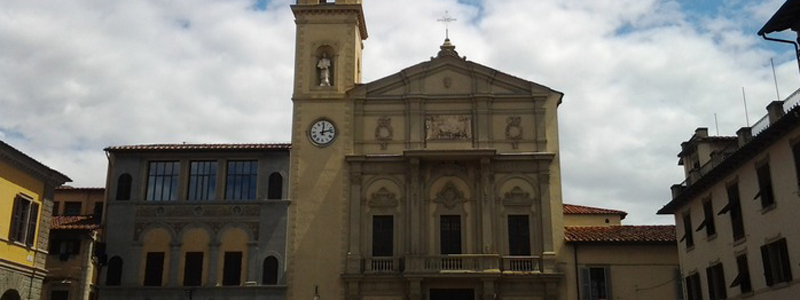
Located in the heart of Montevarchi, the Museum of Sacred Art is adjacent to the illustrious Collegiate Church of San Lorenzo, defined as "one of the most beautiful examples of Tuscan Baroque".
Since 1973, the year of its foundation, the Museum collects and preserves works of rare beauty such as sculptures, frescoes, objects of fine jewelry, sacred furnishings, reliquaries and illuminated manuscripts. Amongst these, liturgical objects and works commissioned by the local Fraternity of the Sacred Milk stand out not only for their historical and artistic importance but also for the uniqueness of the finds. The Fraternity was founded in the 15th century following the gift of the relic, which belonged to the Emperor of Constantinople and later to the King of France, Louis IX, by Count Guido Guerra.
Numerous noteworthy works include:
Robbiano Temple
The "Tempietto" is decorated with glazed terracottas made by the very active Florentine workshop of della Robbia, between the end of the 15th and the beginning of the 16th century.
The delivery of the relic
The large bas-relief with the delivery of the relic and two coats of arms of Montevarchi, now exhibited in the room with the "Tempietto", were originally placed in the front and on the sides of the terrace of blessings, on the facade of the church.
In the center of the panel, Count Guido Guerra, feudal lord of Montevarchi, gives the prior of San Lorenzo the sacred relic of the Milk of the Madonna, obtained from Charles of Anjou, brother of King Louis IX, grateful for the support given to him in the battle of Benevento (1266) and virtually present, kneeling, dressed in French cornflowers. On the left, the retinue of nobles and soldiers, with lances and mounts, advance through the crowd, while on the right a procession of clergymen is moving towards the church. In the background, walls with Guelph battlements, a tower, a bell tower and a dome with a lantern stand out against a deep blue sky.
Shrine of the Holy Milk
The reliquary, in the form of a small temple, in carved ebony wood, with decorations in silver and gilded copper, is the work of Michele Genovini (not. 1626-1669), a Florentine goldsmith with a workshop in Ponte Vecchio, who made it in 1630, on commission from Duke Jacopo Salviati and his wife Veronica Cybo. It was later modified in 1709 by Massimiliano Soldani Benzi (1658-1740), an architect and sculptor of Montevarchina origin, a famous medallist at the grand-ducal court, as well as the author of the project for the baroque restructuring of the Collegiate Church itself.
The precious container, flanked by two columns supporting an entablature, depicts, on the front facade, the Madonna and Child and, on the back, the martyr St. Lawrence, to whom the church is dedicated. Surmounted by a putto with lilies, it rests on a sort of decorated vase, on which the coat of arms of the Salviati dukes stands out clearly.
Processional cross
This large astylar cross, which can be placed on a pole for processional use, is made of embossed and chiselled silver by Pietro di Martino Spigliati (1552). It is the only work that has come down to us by the Florentine goldsmith who was Benvenuto Cellini's assistant.
On the two sides there is an iconographic cycle that synthesizes, with considerable expressive force, the human journey from original sin to redemption, with stories from the Old (back) and the New Testament (front). In all, there are twelve four-lobed panels, six per facade, one of which depicts the coat of arms of Montevarchi (back) and another bears the inscription of the client Fraternita del Latte (front).
On the rear facade we find, at the top, the creation of Adam and Eve, on the left the temptation and original sin, on the right Cain kills Abel, in the centre human work and the lineage of Adam and Eve, at the bottom the sacrifice of Isaac.
On the façade with the crucifixion, instead, at the bottom is the Nativity, on the left the Last Supper, on the right the prayer in the garden, at the top the resurrection, while in the central panel is depicted God the Father separating light from darkness, of Michelangelo's matrix.
Madonna Enthroned with Child and Saints
Fresco detached from S. Andrea a Cennano and attributed to Luberto da Montevarchi (1460-1522), who trained in the circle of Perugino, was his collaborator at the Collegio del Cambio in Perugia and worked a lot in Valdarno.
As testified by the inscription, painted on the sculpted stone architectural element above the throne, it was commissioned by a certain Bartolomeo di Giovanni da Levane.
The Madonna, portrayed in a simple but elegant dress, with a detached and thoughtful expression, holds the Child in her lap, who looks to the side. Flanking the throne, from left to right, are: St. Francis of Assisi, St. Lucia, St. Andrew the Apostle, St. John the Apostle (almost legible), a horseman (St. Martin?) and St. Catherine of Alexandria. In the upper lunette is depicted the adoration of the shepherds.


Leave a Reply